

In this issue:
The first-mile problem, and why it blocked Lightning adoption for years
What Ark actually does and why capital efficiency changes the onboarding math
What Spark does differently and where stablecoin finality fits
How Ark and Spark fit together, on-ramps to the same highway
The SDK layer: how Breez turned protocol complexity into a clean developer interface
What this means if you’re not a Bitcoin developer
The First-Mile Problem
Lightning works. That sentence would have been contested a few years ago. Today it is simply true.
The payment channels are real. The routing is real. The liquidity is real. Wallets like Phoenix and Cake have proven that non-custodial Lightning is not only possible but usable by people who have never heard the words “inbound liquidity.” Strike has processed billions in volume. Cash App has routed Lightning payments to tens of millions of users. The infrastructure held.
But Lightning has a first-mile problem that the industry has spent years deliberating.
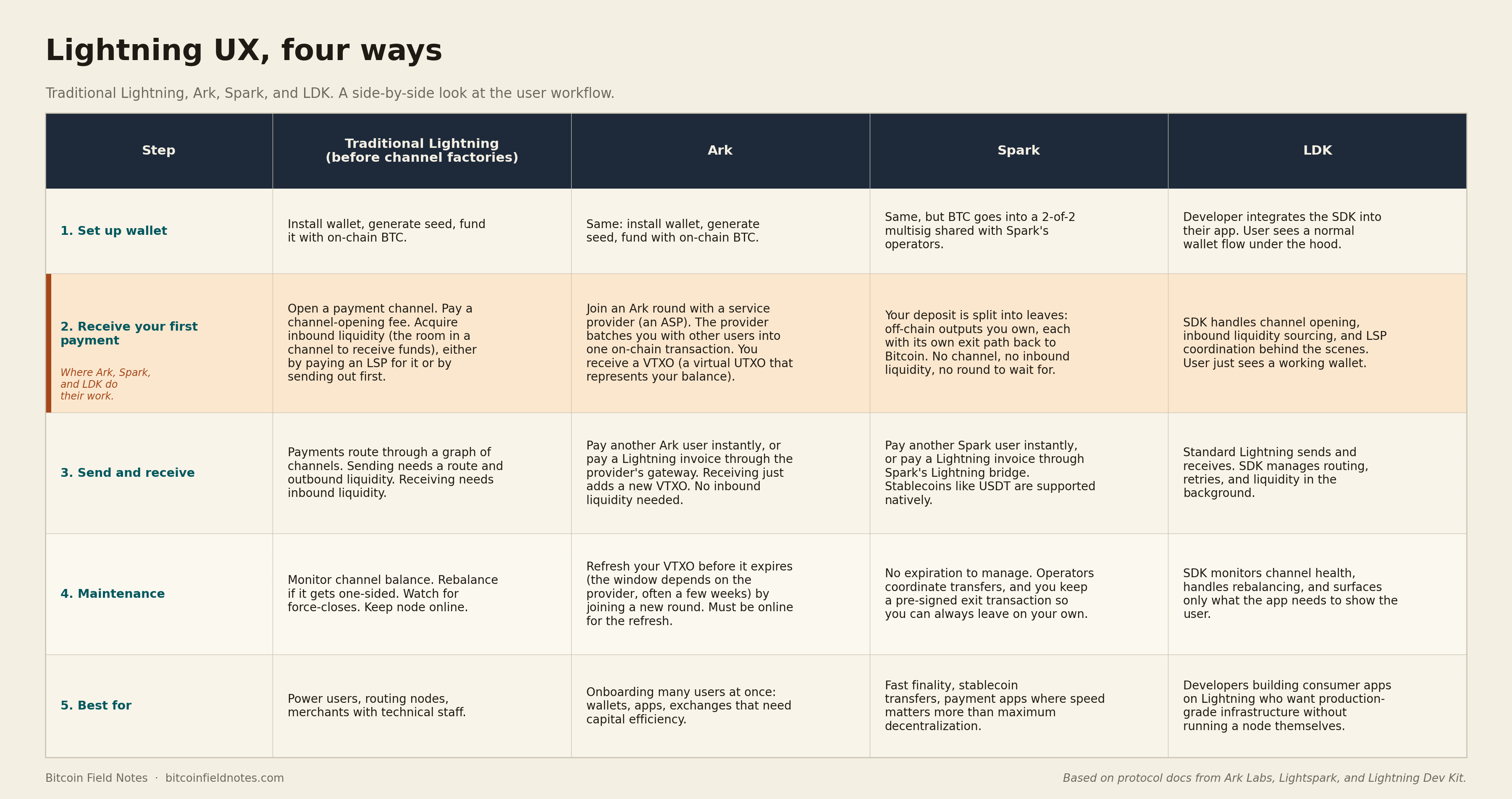
To receive a Lightning payment, you need a channel. To open a channel, you need bitcoin on-chain and a counterparty willing to lock liquidity on your behalf. For a user downloading a wallet for the first time, that sequence is a wall. For a developer building an app that needs to onboard thousands of users simultaneously, it is a business model problem. The cost of opening individual channels for each new user (on-chain fees, capital lockup, operational overhead) doesn’t work at scale.
The rule is simple: no channel, no payment. And every channel costs something to open. This is the first-mile problem. It’s not a bug, but a structural feature of how payment channels work.
The solutions that emerged were mostly workarounds. Custodial Lightning—where a third party holds your keys and manages channels on your behalf—removes the friction entirely. It also removes the point. Submarine swaps and loop-out services let users move between on-chain and Lightning, but they add steps and fees that compound at scale. Channel factories were theorized as a way to amortize on-chain costs across many users, but they remained a research concept for years.
Ark and Spark are not workarounds. They may be the first scalable answers to the first-mile problem that have shipped production code.
What Ark Actually Does
Ark was proposed in May 2023 by developer Burak Keceli, who had previously broken Lightning with a 998-of-999 multisig transaction. Ark is an elegant solution to a hard problem.

The core insight behind Ark is this: instead of users opening bilateral channels with counterparties, they interact with a shared coordinator called an ASP—an Ark Service Provider. The ASP periodically creates what are called rounds. In each round, the ASP pools together a batch of user outputs and commits them into a single on-chain transaction. Users receive what are called VTXOs (Virtual Transaction Outputs), that represent their claim on funds within that round.
The on-chain footprint is minimal. One transaction per round covers potentially hundreds of users. The capital efficiency is dramatically better than bilateral channels because the ASP is managing a shared liquidity pool rather than locking funds bilaterally with each user.
The tradeoff is the VTXO expiration window. VTXOs are not permanent. They have a timeout (currently around four weeks in most implementations), after which the user must either refresh their VTXO in a new round or exit to chain. This is a real operational consideration for wallets building on Ark. A user who goes offline for six weeks and comes back needs a recovery path. That path exists, but it requires planning.
The other consideration is interactivity. VTXO refresh requires the user to be online at the time of the round. This is not a fatal constraint—most payment activity requires some form of online presence—but it is a design consideration that downstream applications need to account for.
What Ark gets right is capital efficiency and onboarding simplicity. A new user can receive their first payment with no prior channel setup, no on-chain transaction, and no liquidity negotiation. The ASP handles the coordination. The user receives a VTXO. They are onboarded.
What Spark Does Differently
Spark comes from Lightspark, a payments infrastructure company purpose-built around the idea that Bitcoin can move money at internet scale. If Ark is an anon developer’s elegant solution to a structural problem, Spark is a well-capitalized company’s pragmatic answer to the same question, built from a different set of assumptions.

Where Ark uses a round-based coordinator model, Spark is built on statechains. A statechain is a mechanism for transferring the ownership of a UTXO off-chain by transferring the private key used to control it. The current owner and the statechain operator co-sign to hand control to a new owner. The on-chain UTXO doesn’t move. Only the key controlling it does.
The original statechain design had a limitation that made it awkward for payments: you could only transfer the entire UTXO. You couldn’t split it. Spark’s key architectural contribution is solving this with what they call leaves. A Spark UTXO can be subdivided into leaves, each representing a fraction of the total. Transfers happen at the leaf level, not the UTXO level. This makes Spark work as a payment system rather than just a settlement layer.
The tradeoff Spark accepts is a different trust model than Ark. In Spark, the statechain operator has some role in the transfer process. The cryptographic design constrains what the operator can do—they cannot steal funds—but they can potentially censor transfers or go offline in ways that would force users to chain. Whether this trust model is acceptable depends on your threat model and your use case.
Spark is optimized for is finality and speed. Transfers within Spark settle quickly, with strong guarantees that don’t depend on routing through a network of channels. For stablecoin transfers, where finality matters more than decentralization, Spark’s model is well-suited. Lightspark has leaned into this explicitly: Spark supports stablecoin issuance natively, and USDT on Spark is already live.
How They Fit Together
Ark and Spark are not competing for the same position. The framing that treats them as rivals misses what’s actually happening.
Think of the Lightning Network as a highway system. It is fast, efficient, and well-traveled. But getting onto the highway requires an on-ramp—a channel, with all the capital and coordination that entails. Ark and Spark are not alternative highways. They are on-ramp infrastructure. They solve the access problem without replacing what Lightning does once you’re moving.
Ark is optimized for onboarding and capital efficiency. A wallet that needs to bring thousands of new users onto Lightning—without asking each of them to pre-fund a channel—can use Ark to onboard them into VTXOs and route payments from there. The ASP absorbs the on-chain coordination. The user gets a payment-ready balance without touching the blockchain.
Spark is optimized for transfer speed and stablecoin use cases. A remittance provider sending USDT between counterparties who trust Lightspark’s infrastructure gets fast, final settlement with minimal on-chain overhead. The statechain model works well when the counterparties are known and the value of finality outweighs the value of permissionless operation.
Both protocols connect to Lightning. That’s the bridge. A user onboarded via Ark can send a Lightning invoice to someone on a standard wallet. A Spark transfer can exit to Lightning for last-mile delivery. The interoperability is real and working.
The more interesting frame is what this stack enables for developers. Before Ark and Spark, building a non-custodial application on Lightning meant managing channel liquidity, handling on-chain fees, and building infrastructure most teams had no business building. The failure mode was going custodial—easier to ship, worse for users, and a regulatory surface that is getting harder to manage.
Ark and Spark change that calculus. The first-mile problem now has infrastructure answers. The question is whether developers can access those answers without themselves becoming infrastructure experts.
That is the question the SDK layer exists to answer.
The SDK Layer
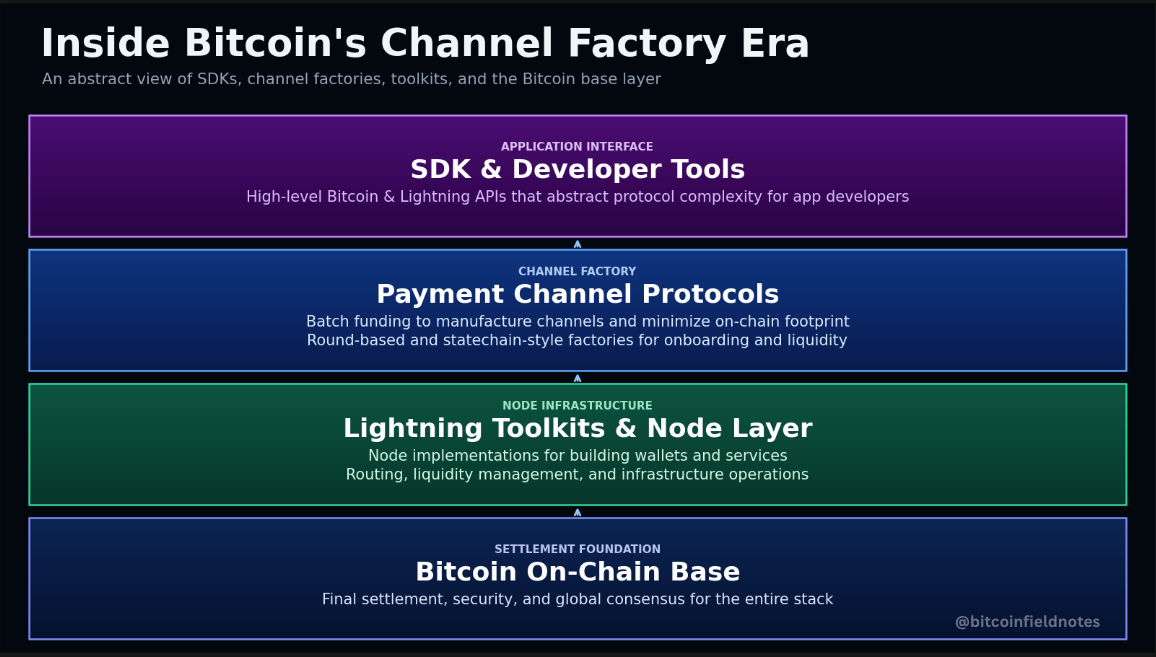
Protocols solve protocol problems. They don’t ship products.
Ark and Spark are remarkable pieces of engineering. But a developer building a messaging app, a marketplace, or a remittance tool doesn’t want to choose between VTXO lifecycle management and statechain finality assumptions. They want to add Bitcoin to their app. Cleanly. Quickly. Without becoming a Lightning infrastructure expert in the process.
That’s the job the SDK layer exists to do.
There’s an analogy worth borrowing here, one Breez themselves use. The invention of the digital camera sensor was a hardware breakthrough. But what made Instagram, Snapchat, and TikTok possible wasn’t the sensor…it was the camera API. The clean interface that let any app developer call a function, get an image, and build something entirely new on top of it without understanding the optics, the sensor architecture, or the compression algorithm underneath.
Ark and Spark are like the camera sensor breakthrough. The Breez SDK is the camera API.
Breez isn’t the only player in this layer.

The Lightning Development Kit (LDK), built by Spiral, takes a parallel but distinct approach. (Spiral is Block’s open-source Bitcoin team.) Where Breez abstracts the entire protocol layer behind a single interface, LDK is a Rust library that developers embed directly into their applications. More modular, more flexible, and built for teams that want lower-level control of their Lightning stack.
These are different philosophies for the same problem. Breez bets that most developers want Lightning to be a function call. LDK bets that some developers want Lightning to be a library they can shape. The fact that both have shipped, both are in production, and both have meaningful adoption is itself the signal: the developer friction that blocked Lightning adoption is being attacked from multiple angles at once.
There’s also a Block angle worth surfacing. Cash App has routed Lightning payments to tens of millions of users. Square is rolling out Lightning point-of-sale acceptance to merchants. Block has proven, at scale, that Lightning works as consumer and merchant infrastructure. Spiral’s LDK is the open-source toolkit that came out of that experience, available now to any team that wants to build on the same foundation.

Breez has been building non-custodial Lightning infrastructure since the early days of the network. Their Nodeless SDK is what that experience has produced: a developer integrates the SDK, the SDK handles what’s underneath, whether that’s Lightning, Spark, or future protocols as the ecosystem evolves.
That abstraction is already running in production. The Breez Nodeless SDK runs on Spark today, and has already patched a live privacy flaw (a flaw that caused wallet implementations to leak user Spark addresses). Other implementations hadn’t caught it. Breez fixed it quietly, in production, before most people knew it was a problem.
It’s not a marketing claim. It’s a signal about how Breez operates: close to the protocol layer, attentive to the tradeoffs, and shipping fixes rather than filing issues.
For developers, the practical implication is significant. You don’t have to wait for Ark or Spark to fully mature, resolve their remaining tradeoffs, or converge on a single dominant model. The SDK absorbs that uncertainty. You build on the interface. The interface handles the rest.
For anyone evaluating where Bitcoin infrastructure is heading, the implication is different but equally important. The layer that historically blocked developer adoption (the complexity of non-custodial Lightning) now has a clean abstraction sitting on top of it. The barrier to “Bitcoin in every app” just got meaningfully lower.
It’s not theoretical. The SDK exists. It’s in production. Developers are using it.
What This Means in Plain Terms
If you’re not a Bitcoin developer, if you’re following this ecosystem because of what it means for products, businesses, and markets — this section is for you.
The developer friction that blocked Lightning adoption at scale is being systematically removed. For years, the gap between “Lightning works in theory” and “Lightning works in my app” was wide enough that most serious builders either went custodial or walked away. That gap is closing. Ark and Spark are production infrastructure, not research papers. The Breez SDK is a shipping product with real integrations. The excuse of “too hard to build on” is getting harder to make.
Multi-asset value transfer is live on these rails right now. This is not a roadmap item. USDT runs natively on the Lightning Network via Taproot Assets. Spark supports stablecoin issuance and transfer. Ark Labs has announced token protocol support. The stablecoin highway this series has been mapping since August 2025 now has on-ramps.
The window for early positioning is open, but it is not permanent. Bitcoin infrastructure tends to follow a pattern: years of difficult, unglamorous building followed by a moment when the mainstream notices all at once. We are in the building phase. The moment of mainstream recognition has not arrived yet. That gap between what is technically true today and what the market has priced in, is where the interesting decisions get made.
Breez put it well: it’s 2007, the iPhone just dropped, and developers are starting to play with the camera API. That’s not a marketing line. That’s where the stack actually sits right now. The hardware breakthrough happened. The interface layer is shipping. The app ecosystem that builds on top of it has barely started.
For wallets, exchanges, PSPs, remittance providers, messaging apps, and marketplaces, the question is no longer whether Bitcoin infrastructure is ready. The question is how quickly your team can move.
The Bitcoin ecosystem at work
This evolution in UX just...happened. There was no governance vote, no protocol upgrade required. A developer named Burak looked at the inbound liquidity problem and decided it was solvable. Lightspark looked at the statechain model and decided leaves could fix what whole-UTXO transfers couldn’t. Breez looked at the developer experience and decided the whole stack needed a cleaner surface.
This is what Bitcoin looks like when it fixes itself.
Not loudly. Not with announcements timed to news cycles. Quietly, in public repositories, in production deployments, in SDKs that ship privacy fixes before most people know the vulnerability exists.
The first-mile problem that limited Lightning for years has real answers now. The stack is more complete than it has ever been. The developers who figure that out first won’t just build better apps—they’ll define what apps can do.
It’s 2007. The camera API is open. The Bitcoin ecosystem is at work.
Bitcoin Field Notes is an independent research series covering Bitcoin infrastructure, developer tooling, and the emerging multi-asset payment stack.