

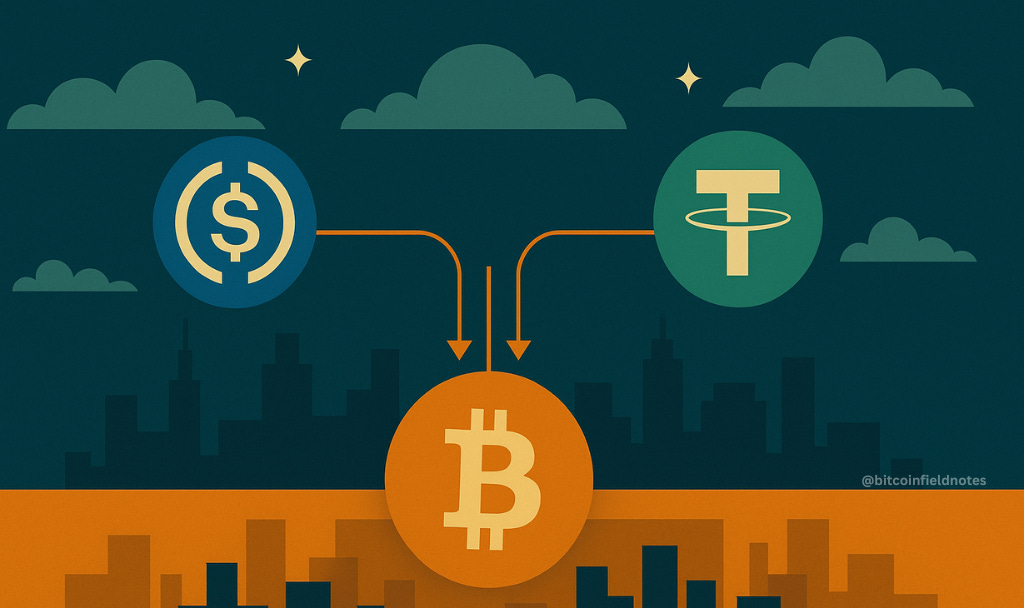
In June 2025, Tether launched USDT on Bitcoin’s RGB Protocol, and in August 2025, it co-funded the Plasma sidechain - two very different paths toward Bitcoin-native stablecoins.
Circle, issuer of USDC, is approaching the same goal from the opposite direction, piloting Taproot Assets and Lightning integrations to bring regulated stablecoins to Bitcoin.
Together they reveal a new balance between privacy and compliance, minimalism and usability, as Bitcoin evolves from store of value to settlement layer for the digital-dollar economy.
I. Why Bitcoin-Native Stablecoins Matter Now
In the summer of 2025, the world’s largest stablecoin quietly redrew Bitcoin’s technical map.
Tether’s announcement that it would bring USDT to the RGB Protocol, a privacy-focused Layer 3 built atop Bitcoin and Lightning, signaled that stablecoins and Bitcoin were no longer separate conversations. And while Tether built outward from Bitcoin’s edges, Circle began building inward from the U.S. banking system, two empires racing toward the same neutral ground.
Three forces converged to reopen the question of Bitcoin’s role in digital dollars: regulation, infrastructure, and market pressure.
The GENIUS Act transformed stablecoins from grey-market instruments into federally sanctioned digital cash. Compliance became a moat, not a handicap.
Taproot, activated in 2021, quietly enabled protocols like RGB, using “single-use seals” to attach assets to Bitcoin’s UTXO model. Plasma soon followed, an EVM-compatible sidechain secured by BTC collateral.
Meanwhile, Lightning’s Taproot Assets protocol proved that fiat-denominated tokens could move across Bitcoin’s instant-payment rails. The walls between “digital gold” and “digital dollars” were dissolving.
I.5 The Incumbent: Why Liquid Already Did This
Before RGB issued a satoshi of stablecoin and before Plasma raised its seed round, Liquid was already moving Tether on Bitcoin rails. USDT launched on the Liquid Network on July 29, 2019.
Liquid is a federated sidechain launched by Blockstream in 2018 with 23 founding members drawn from the exchange and trading community. Fifteen functionaries sign blocks today. Specialized hardware. Operated by a subset of the Federation. Pegged Bitcoin sits behind an 11-of-15 multisig. Not Bitcoin Layer 2 in the trust-minimized sense. A permissioned execution environment that settles to Bitcoin.
The track record is real. Confidential Transactions hide both amounts and asset types by default; even functionaries cannot decrypt them. The Blockstream Mining Note, a Luxembourg-regulated securitization, ran a three-year term on Liquid. El Salvador’s $1B tokenized Bitcoin Bond was structured on Liquid via Blockstream AMP. In November 2021, Liquid became the first blockchain to natively support Simplicity, adding 31 opcodes for covenants and transaction introspection. Boltz Chain Swaps shipped in May 2024, enabling non-custodial swaps between Liquid and Lightning.
Liquid answers a different question than the contracts ahead. The Federation model trades one trust assumption for another. You no longer rely on an issuer’s solvency, but you do rely on fewer than five functionaries colluding or failing at once. For exchanges, market makers, and regulated issuers, that is a clean tradeoff. For users who read “Bitcoin-native” as trust-minimized to Bitcoin’s own validation, it is not.
Liquid proved the demand. The next generation of contracts is seemingly after something stricter: stablecoins where the only thing you trust is Bitcoin.
II. The Hedge: Inside Tether’s Dual Bet on RGB and Plasma
On the surface, RGB and Plasma could not look more different.
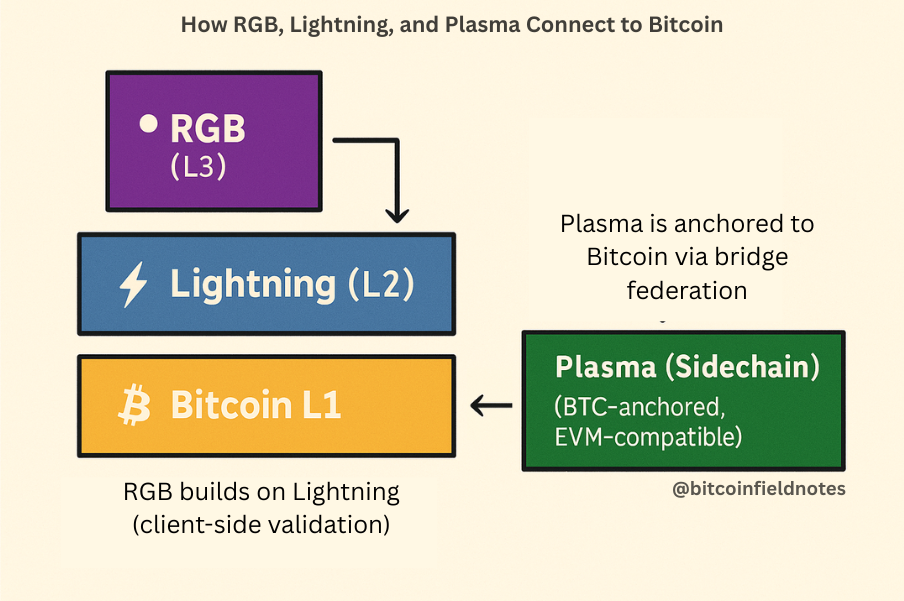
RGB embeds assets directly into Bitcoin’s UTXO structure via client-side validation: no global state, no extra chain, just cryptographic proofs exchanged peer-to-peer through Lightning.
Plasma is a full EVM-compatible sidechain collateralized by BTC, offering smart-contract composability and auditability.
RGB is the maximalist’s ideal: private, decentralized, zero-change to consensus, but it suffers from complexity and thin adoption. Plasma is its mirror image: fast, compliant, and developer-friendly, though it relies on federation trust.
Together they form Tether’s infrastructure hedge: one bets on ideology, the other on integration.
III. Lightning’s Middlegame: The Router That Binds
Lightning was never meant to do everything. It was meant to do one thing fast. That modest design now makes it the neutral switchboard of Bitcoin’s emerging monetary fabric.
With Taproot Assets and stablecoin extensions, Lightning can route digital dollars as easily as sats. RGB uses it for private transport; Plasma will rely on it for compliant last-mile payments.
Lightning’s architecture trades capital efficiency for security. Every payment channel must be funded in advance and balanced across participants, ensuring users retain custody of their funds at all times. But that safety comes at a cost: liquidity must be locked before it can move. Large or complex payments can fail if sufficient capacity isn’t already distributed along a viable route.
This makes liquidity management Lightning’s defining constraint. It’s not a weakness of design; it reflects the network’s trust model. The network functions like a collection of private corridors rather than a shared pool. This preserves sovereignty but complicates scaling. Operators must continuously rebalance channels and allocate capital efficiently to maintain throughput. As stablecoin flows join the network via Taproot Assets, this balancing act becomes even more critical.
Still, if RGB and Plasma represent rival philosophies, Lightning is the connective tissue, the practical layer where they meet the market. It turns the theoretical into the transactional, linking Bitcoin’s ideological purity with real-world utility.
Lightning doesn’t have to win the protocol war; it has to own the last mile.
IV. What Makes a Stablecoin “Bitcoin-native”
In today’s market, calling a stablecoin Bitcoin-native is a powerful marketing edge, an appeal to ideology and user trust. But what does Bitcoin-native actually mean? In practice, each protocol earns the posture through a different approach.
RGB
RGB is the purest expression of Bitcoin minimalism: private and censorship-resistant, but possibly complex for users and light on liquidity.
RGB stakes the structural claim. State stays client-side. Nothing global writes to chain. The UTXO model carries through directly, and consensus stays unchanged. RGB's bet: nativeness lives in design integrity. To extend Bitcoin, you have to also be Bitcoin.
RGB is Bitcoin minimalism applied to stablecoins. No new chain, no new consensus, no compromise.
Plasma
Plasma anchors directly to Bitcoin’s value layer while importing Ethereum-style programmability. It’s pragmatic and institution-friendly: transparent, auditable, and fast, but dependent on federated bridges and less philosophically “pure.”
BTC collateralizes the bridge, Solidity executes above it, and finality flows back to Bitcoin's base layer. The bet here is gravitational. What resolves to Bitcoin counts as Bitcoin, even when execution happens elsewhere.
Plasma is secured by Bitcoin’s value layer, but optimized for composable, regulated scale.
Lightning
Lightning stakes the functional claim. It already moves Bitcoin globally. With Taproot Assets, the same rails now move stablecoins. No new home, no parallel infrastructure. Just extension. The bet: the network Bitcoin already uses is the network Bitcoin's dollars should use. It’s where settlement happens: quick, practical, and nearly invisible.
Lightning is the layer where Bitcoin rails touch the real economy.
Liquid
Liquid stakes the tenured claim. Six years of regulated assets on Bitcoin rails. USDT since 2019. The Blockstream Mining Note. El Salvador's bond. Confidential Transactions and Simplicity contracts in production. It brings production-readiness. While RGB perfects privacy and Plasma races toward institutional compatibility and Lightning binds them, Liquid has been live since 2018, has carried real securities, and has shipped Simplicity contracts.
While the others are still emergent, Liquid is the incumbent with proven history issuing USDT on Bitcoin rails.
Four claims. None invalidating the others. Together, they define the contest.
V. The Stakes: How the Bitcoin Dollar War Ends
Whatever you believe Bitcoin to be, it’s becoming something more in 2025: the settlement fabric of digital dollars. Each protocol imagines a different endgame.
Scenario 1: RGB Future: Private money returns. Transactions become local proofs, not public ledgers. Liquidity fragments; privacy reigns.
Scenario 2: Plasma Future: Bitcoin becomes a regulated settlement hub. Trillions in institutional stablecoin volume anchor to BTC-secured sidechains.
Scenario 3: Lightning Future: Bitcoin becomes the transport layer: fast, asset-agnostic, routing liquidity between the other two.
Scenario 4: Liquid Persists: The trust-minimized contracts take longer to mature than expected. Liquid remains the production venue for regulated issuance through the decade. RGB, Plasma, and Lightning evolve in parallel, but the institutional flows stay where they have been since 2019.
Tether’s strategy now spans four rails (Liquid for live institutional flow, RGB for privacy, Plasma for programmability, Lightning for routing) functioning like portfolio diversification across regulatory weather.
Yet Tether isn’t alone in reshaping Bitcoin’s monetary map. As one issuer builds optionality through decentralization, another is mapping a different route entirely, one paved in compliance.
The Circle Factor: Compliance Finds Its Way to Bitcoin
Circle, the issuer of USDC, approaches Bitcoin from the opposite direction: compliance first, infrastructure second.
After the GENIUS Act, Circle became the model issuer: audited reserves, bank-grade custody, and public-company accountability. Now it’s extending that regulatory credibility onto Bitcoin’s rails, translating its fintech playbook into protocol form.
Lightning / Taproot Assets - Circle’s pilots with Lightspark and Voltage test USDC-over-Lightning for B2B payments and cross-border settlement: instant, low-cost, and final. These trials turn Lightning into a compliance-friendly conduit for regulated stablecoin flows.
Plasma - A natural fit. Its EVM compatibility and transparent validator sets satisfy Circle’s audit requirements. USDC could launch there with minimal friction and full observability.
RGB - Unlikely. Its encrypted, client-side architecture conflicts with Circle’s reporting obligations and audit standards.
Together, these moves are shaping a two-pole ecosystem:
Tether + RGB / Plasma → permissionless rails
Circle + Lightning / Taproot Assets → regulated rails
Bitcoin stands beneath both, neutral and indispensable: the monetary DMZ of the digital-dollar era.
Tether built liquidity from the edges of finance; Circle is rebuilding trust from its center. Their convergence on Bitcoin marks the closing of the stablecoin divide.
In 2025, the old line between offshore and regulated stablecoins has blurred. Tether now carries Wall Street credibility through Cantor Fitzgerald’s backing, while Circle exports Washington’s compliance model into Bitcoin’s new infrastructure.
VI. Bitcoin as the Settlement Layer for the Dollar Internet
Bitcoin’s third act is unfolding quietly: becoming the settlement substrate for digital dollars.
The dollar is already digital; what it has lacked is an immutable base. Bitcoin’s fixed rules and auditability make it that base. Ethereum provided programmability, Tron reach; Bitcoin provides finality.
As Lightning, RGB, and Plasma evolve, every stablecoin transaction increasingly seeks settlement against Bitcoin’s security. Bitcoin doesn’t compete with the dollar, it grounds it.
Lightning handles movement, Plasma handles logic, RGB handles privacy, Liquid handles regulated production. Together they form a polycentric monetary internet on Bitcoin.
Economically, routing fees, bridge yields, and custody premiums tie network security directly to real demand for settlement.
Politically, the system balances transparency and autonomy: regulators get verifiable rails; users keep choice.
Tether’s infrastructure hedge and Circle’s compliance bridge both lead to the same outcome, Bitcoin as the neutral clearing layer of global finance.
Together, these layers expand Bitcoin’s functionality and also redefine its identity.
Bitcoin may no longer be what we store. It can become where we settle.
Epilogue: Settlement as Story
History rarely names its infrastructures while they’re being built.
Gold was just metal until it became money.
TCP/IP was just plumbing until it became the internet.
Bitcoin remains an asset and a ledger, but it may be becoming something larger: an atmosphere for value, a language for exchange.
If this is the dollar’s internet, Bitcoin may be its quiet syntax: invisible, neutral, essential. It doesn’t announce itself in headlines or prices; it simply settles things. Permanently.